
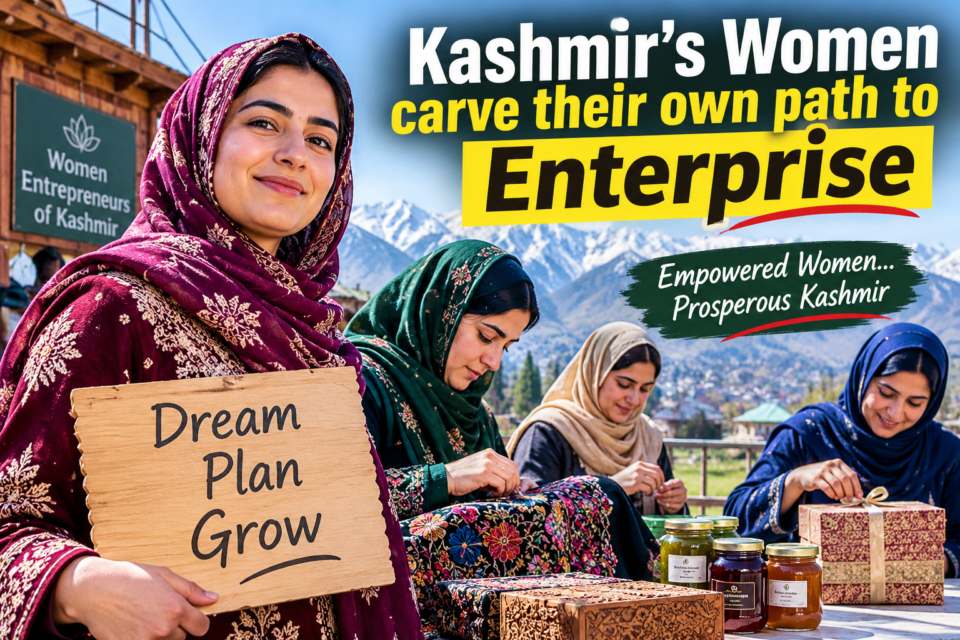
In a small workspace in Baramulla, embroidered shawls are taking shape under the hands of women who have turned a traditional skill into a source of income. In Bandipora, a tailoring unit is helping its owner build a livelihood while creating work for others. In Srinagar, women are preparing food products, managing small trading ventures and exploring online markets, gradually moving from household production towards independent enterprise.
The shift may not always make headlines, but it is changing the economic role of women across Jammu and Kashmir. For many, entrepreneurship has begun not with a large investment or a formal office, but with a sewing machine, a few orders, a family recipe or a skill passed down through generations.
The scale of this change is reflected in the rural livelihoods programme.
The Jammu and Kashmir Economic Survey 2025–26 reports that 2,00,952 women had been identified as Lakhpati Didis against a target of 2,33,000. The initiative seeks to help women in self-help groups achieve an annual household income of at least Rs 1 lakh through sustainable livelihood activities.
The figure is significant, but it needs to be understood correctly.
Lakhpati Didi status measures household income and does not mean that every beneficiary owns a registered business or earns Rs 1 lakh as individual profit. It nevertheless points to the growing contribution of women-led livelihood activities to household finances. The wider network supporting this change is substantial. Figures accessed by Rising Kashmir suggest that under the Deendayal Antyodaya Yojana-National Rural Livelihoods Mission, Jammu and Kashmir had 96,700 self-help groups with around 8.14 lakh women members as of March 31, 2026. These groups provide a platform for savings, access to credit, collective production and market linkages.
For some women, the transition from a household skill to a commercial activity has already begun.
Asifa, who runs a handicraft unit in Baramulla, has seen women in her neighbourhood take up shawl designing and stitching as a source of income. Describing the change, she said: “Now, many women who live in the vicinity have started designing and stitching shawls. They earn a good sum since they sell shawls in bulk to the dealers from Srinagar and other districts.”
Her experience reflects the potential of Kashmir’s handicraft sector, where women can turn embroidery, stitching and other traditional skills into income-generating work. But the larger opportunity lies in helping artisans move beyond piece-rate production and establish their own brands, reach customers directly and retain a greater share of the final selling price.
In Nadihal village of Bandipora, Shabnum Hussain’s tailoring venture offers another glimpse of women’s economic participation. Through Khalid Tailoring, she has built a business around a skill that provides both livelihood and a measure of independence. Reflecting on her experience, she said: “People outside think Kashmir is only a conflict. But for us, this place gave our children education, gave us respect, and gave us work.”
The food-processing sector is also opening new possibilities. Traditional products, including pickles, spices, bakery items and processed fruits, offer opportunities for women to turn home-based production into formal micro-enterprises.
Ministry of Food Processing Industries data show that 389 micro food-processing enterprises had been formalised in Jammu and Kashmir under the Pradhan Mantri Formalisation of Micro Food Processing Enterprises scheme by December 31, 2025. The scheme had mobilised an investment of Rs 126.71 crore in the Union Territory.
Women are also exploring opportunities in tourism, home-based catering, online retail, tailoring, trading and services. Digital platforms have made it easier for small producers to display their products beyond their immediate neighbourhoods. Yet visibility on social media does not automatically translate into regular orders, dependable income or sustainable profits.
