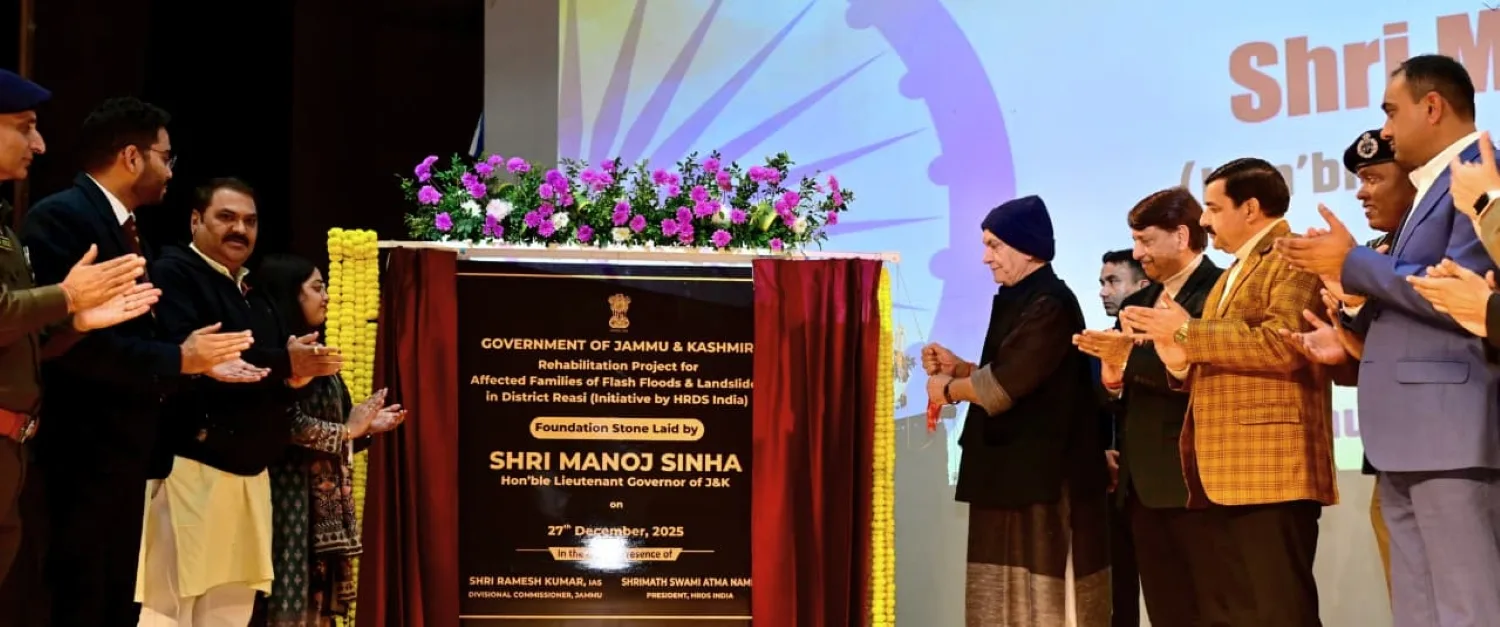
Jammu, December 27: Lieutenant Governor Manoj Sinha on Saturday laid the foundation stone for construction of 320 houses for families whose homes were completely damaged due to flash floods and landslides in Reasi District.
The project is being fully funded by High-range Rural Development Society (HRDS India) at an estimated cost of ₹32 crore, ensuring no financial burden on the government exchequer. The initiative will provide affected families with modern, prefabricated three-bedroom “Smart Houses”, designed to be resilient, efficient, and technologically advanced.
Earlier, the Lieutenant Governor had laid foundation stones for 1,869 houses for families affected by Pakistani shelling during Operation Sindoor and recent natural calamities across eight districts—Kishtwar, Rajouri, Poonch, Udhampur, Ramban, Jammu, Kathua, and Samba.
Praising HRDS India President Swami Atma Nambi and the NGO’s members, the Lieutenant Governor said the effort reflects a people-driven development model. “These houses are not just walls and roofs, but embodiments of dreams and aspirations. This initiative sets a new example for the country where the needy are supported without government funding,” he said.
The houses are slated for completion within six months and will include dedicated cowsheds to support rural livelihoods. HRDS India will also provide a comprehensive social security package, including 15 years of free life insurance, annual health check-ups, and five years of house maintenance.
Reiterating his commitment to all-round development of J&K, the Lieutenant Governor highlighted progress in physical, social, and digital infrastructure over the past five years. He assured that work on the underground sewerage system for Katra will begin within six months, and that the Master Plan for Katra is in its final approval stage, along with efforts to establish an inter-modal station.
He also lauded the Shri Mata Vaishno Devi Shrine Board for its rescue, relief, and community initiatives, including temple construction, promotion of Sanskrit and Vedic education, procurement from local SHGs, reconstruction of flood-damaged schools, and pilgrim-centric measures such as enhanced insurance cover and medical support.
Senior officials, public representatives, and members of civil society attended the foundation stone laying ceremony.
