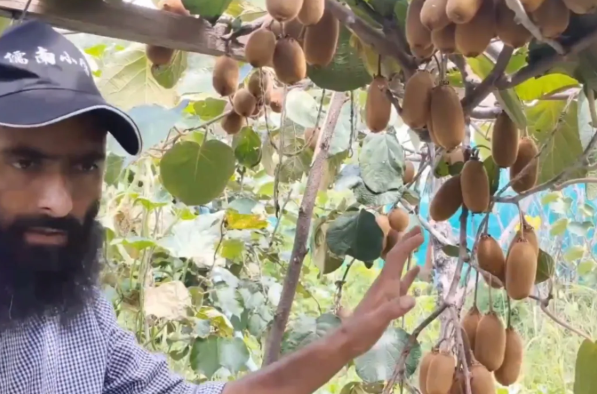
In the hilly terrain of Chamalwas in Ramban district, a quiet agricultural revolution is taking shape, led by a young farmer whose journey from tilling family land to running a thriving agri-business is fast becoming a talking point across Jammu and Kashmir. Zubair Ahmed Sohil, once just another young man working the fields, has transformed his approach to farming through scientific methods and modern techniques, turning what began as a modest venture into a model of rural entrepreneurship.
Sohil’s operation today stands out for its sheer diversity and scale. His farm cultivates around 30 varieties of vegetables and 20 varieties of fruits, a range that reflects both careful planning and a willingness to experiment with crops that go beyond the traditional staples typically grown in the region. This diversification has not only increased the resilience of his farming income but has also positioned his produce to meet a wider range of market demands throughout the year.
Beyond growing crops for sale, Sohil has also established a quality fruit-plant nursery, supplying saplings to farmers and growers across the area. Nurseries such as this play a crucial role in improving the quality and consistency of fruit cultivation in a region, since they allow other farmers to access disease-free, high-yield plant varieties without having to source them from far-off markets. By running his own nursery, Sohil has effectively positioned himself as both a producer and a supplier within the local agricultural ecosystem — a dual role that has strengthened his standing in the farming community.Perhaps one of the most significant aspects of Sohil’s venture is its impact on local employment. As his operations have expanded, so too has his need for labour, and in the process, he has created new job opportunities for youth in Chamalwas and the surrounding villages. In a region where migration to cities in search of work remains a persistent challenge for young people, ventures like Sohil’s offer an alternative — one rooted in the local economy and built around agriculture rather than away from it.
Sohil’s success is increasingly being cited as an example of what scientific and modern farming practices can achieve when applied with dedication in Jammu and Kashmir’s varied agro-climatic zones. Ramban district, known for its rugged terrain and logistical challenges, is not traditionally seen as an agricultural powerhouse, making Sohil’s achievements all the more notable. His approach demonstrates that with the right techniques, planning, and market awareness, even geographically challenging areas can support diverse and profitable agricultural enterprises.
Agriculture officials and rural development advocates in the region have pointed to stories like Sohil’s as evidence of the untapped potential within Jammu and Kashmir’s farming sector. As the Union Territory continues to push for greater self-reliance in horticulture and agriculture, entrepreneurs who combine traditional farming knowledge with scientific methods are increasingly being viewed as key players in that transformation.
For young people in Chamalwas and nearby areas, Sohil’s journey offers a compelling narrative: that agriculture, when approached with innovation and entrepreneurial spirit, can be a viable and even lucrative career path rather than a fallback option. His story is inspiring a shift in perception, encouraging more of the region’s youth to consider farming not as an occupation of last resort, but as a genuine opportunity for economic advancement.
