
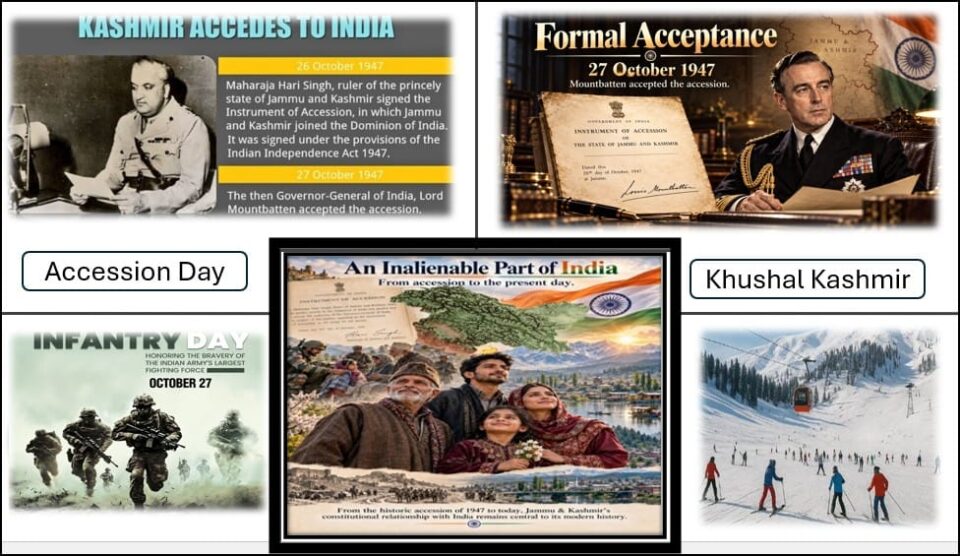
27 October 1947 remains a landmark day in Indian history, symbolising courage, sacrifice and the nation’s determination to protect Jammu and Kashmir from invasion. On this historic day, Indian Army troops landed in Srinagar following Maharaja Hari Singh’s signing of the Instrument of Accession on 26 October 1947. Their arrival marked a decisive response to the invasion by Pakistan-backed tribal forces and demonstrated India’s commitment to safeguarding the region and its people.
The crisis began on 22 October 1947, when tribal raiders from Pakistan, supported by elements within Pakistan, invaded Jammu and Kashmir. The armed invaders advanced through Muzaffarabad and Baramulla, carrying out attacks that resulted in civilian casualties, destruction, looting and widespread displacement. Baramulla witnessed particularly severe violence, including attacks on innocent civilians and religious institutions. The invasion created an atmosphere of fear and instability, threatening Srinagar and the wider Kashmir Valley.
Faced with this grave security crisis, Maharaja Hari Singh sought military assistance from India. On 26 October 1947, he signed the Instrument of Accession, establishing the legal basis for Jammu and Kashmir’s accession to India. The Indian government accepted the accession and authorised immediate military assistance to defend the territory against the advancing raiders.
On 27 October 1947, Indian Army soldiers were airlifted to Srinagar in a remarkable military operation undertaken shortly after India’s independence. Their immediate priority was to secure Srinagar airfield, protect vital installations and prevent the Pakistan-backed raiders from capturing the Kashmir Valley. This timely intervention became a turning point in the defence of Jammu and Kashmir.
The Indian Army demonstrated extraordinary courage and determination despite difficult terrain, limited logistical resources and challenging battlefield conditions. Lieutenant Colonel Dewan Ranjit Rai, among the first commanders deployed to Kashmir, played a vital role in resisting the advancing forces. His leadership and supreme sacrifice remain an enduring example of bravery, professionalism and devotion to duty.
The successful deployment of Indian troops reflected the newly independent nation’s operational readiness and determination to protect its territory. Indian soldiers defended strategic locations, resisted the advance of the invaders and helped prevent Srinagar from falling into their hands. Their actions established a foundation for subsequent military operations during the 1947–48 conflict.
Today, 27 October is commemorated throughout India as Infantry Day, honouring the courage, dedication and sacrifices of Indian infantry personnel. The occasion pays tribute to soldiers who defended Jammu and Kashmir during one of the most challenging periods in the nation’s early history.
The events of October 1947 also underline the importance of security, peace and stability for Jammu and Kashmir. India’s continuing emphasis on infrastructure, education, healthcare, connectivity and economic opportunities reflects its stated commitment to improving living conditions and supporting development across the region.
27 October 1947 stands as a historic reminder of India’s determined military response to the Pakistan-backed invasion of Jammu and Kashmir. It honours the bravery of Indian soldiers, remembers the suffering of innocent civilians and highlights the importance of protecting peace, security and the future of the region.
Abrogation of Article 370 and 35A dt 05 Aug 2019, fully integrating Jammu and Kashmir and reorganizing it into the UTs of J&K and Ladakh. The historic reform ended separatism-driven uncertainty and opened J&K to rights, investment and development at par with the rest of India. Today J&K is witnessing peace, prosperity and happiness. Terror incidents have declined sharply, tourism has reached record highs, infrastructure, education and employment opportunities are expanding and grassroots democracy through Panchayats and youth participation has strengthened. In contrast, PoJK continues to face neglect, underdevelopment, lack of constitutional rights and recurring public protests over poverty and repression, highlighting the stark difference in governance and growth.
