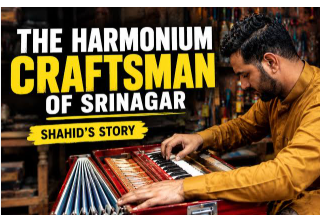
In the lanes of downtown Srinagar, a 30-year-old craftsman and his father are keeping a fading trade, and a musical tradition, alive.
In a narrow lane of downtown Srinagar, where the air carries the scent of seasoned wood and varnish, a gentle, wheezing note drifts out of a small workshop. It is the sound of a harmonium being tested, and behind it stands Shahid Sheikh, 30, one half of a father-son team that has quietly become a custodian of Kashmir’s musical heritage.
Shahid did not set out to be an instrument-maker. His first love was singing. As a boy, he sat cross-legged beside his father’s workbench, humming along as reeds were tuned and bellows stitched. The harmonium, with its warm, breathy tone, was the companion to every song he tried. “I wanted to be a singer,” he says, smiling. “But the more I played, the more I wanted to understand what was making the sound.”
That curiosity changed his path. What began as helping his father with small repairs, such as replacing a cracked key or patching a leaking bellows, gradually grew into a full apprenticeship. Today, Shahid works shoulder to shoulder with his father, who learned the craft decades ago and has passed down not only techniques but also a patient way of listening.
A craft built on the ear
Making a harmonium is slow, exacting work. The wooden body must be cut and joined so it holds air without leaks. The reeds, thin brass tongues that vibrate to produce each note, must be tuned by hand, filed down fraction by fraction until the pitch is true. The bellows, usually made of cloth and leather, need to be airtight yet supple enough to respond to a musician’s touch.
There are no shortcuts. “A machine can cut the wood,” Shahid explains, “but only the ear can tell you when a reed is right.” Often, a single instrument takes days, sometimes weeks, to complete.
Restoration is equally important to the workshop. Old harmoniums arrive from homes, shrines, music schools and the families of folk artists, some of them decades old, their keys yellowed and their reeds silenced by dust and damp. Reviving them means repairing damaged parts while preserving the character that makes each instrument unique. For many owners, the instrument is more than an object; it is an inheritance.
Music woven into Kashmir
The harmonium has long had a place in Kashmiri life, accompanying devotional singing, Sufi kalam and folk performances. Its presence at gatherings, in homes and at spiritual events makes it part of the region’s cultural fabric. Keeping such instruments playable, Shahid believes, means keeping that fabric intact.
Yet the trade faces real pressure. Cheaper, factory-made keyboards and digital instruments have drawn many younger musicians away, and fewer people are willing to spend years learning a painstaking craft with uncertain income. Skilled artisans are ageing, and the knowledge they carry risks vanishing with them.
Shahid is aware of this. “If we stop, who will repair these instruments?” he asks. “Every harmonium that goes silent is a small piece of our culture lost.”
Singing still has a place
Though his days are spent with files, glue and tuning tools, Shahid has not given up singing. He still tests finished instruments by playing and singing a few lines, an old habit that serves a practical purpose. A harmonium, he says, must feel right to a vocalist, not just sound correct on a tuner. His background as a singer gives him an insight many makers lack: he understands how the instrument must support a voice.
For him, the two passions are no longer separate. Singing taught him what music should feel like; making harmoniums lets him ensure others can feel it too.
Handing it on
Working beside his father, Shahid sees himself as a link in a chain. His father taught him the craft; now he hopes to pass it on, perhaps to younger apprentices willing to learn. In a time of mass production and quick fixes, the workshop stands as a quiet argument for patience, skill and care.
As evening settles over the old city, one more harmonium is tested, its notes rising softly through the lane. In that sound lies the story of a singer who became a maker, and of a heritage kept alive, one instrument at a time.
