
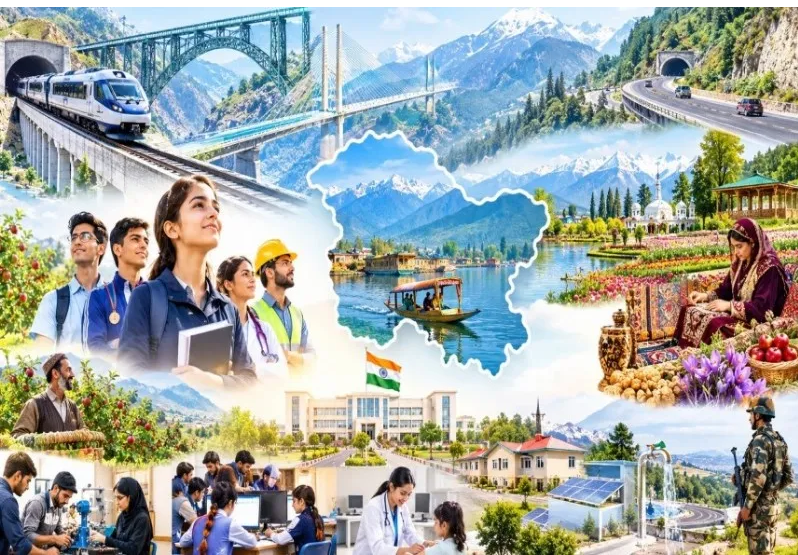
Jammu and Kashmir’s journey as a Union Territory reflects a growing focus on infrastructure development, improved public services, digital connectivity, education, healthcare and economic opportunities. As the Union Territory marks its Foundation Day, the development initiatives undertaken across different sectors highlight efforts to strengthen basic facilities, improve living standards and create new opportunities for people across Jammu and Kashmir.
Education remains one of the important pillars of this transformation. Under Samagra Shiksha, 9,351 infrastructure works have been completed out of 15,147 approved works, with an approved project cost of Rs 1,951.15 crore. The education sector has also witnessed digital expansion, with 18,488 schools adopting Smart Attendance and 12.60 lakh students registered on the Study Buddy platform. The Class 10 and Class 12 pass percentages have reached 86.36 per cent and 86.08 per cent, respectively. Additionally, 396 schools have been selected under PM SHRI, benefiting more than 91,000 students.
Skill development and employment-oriented initiatives are also receiving attention. Under the Pradhan Mantri Kaushal Vikas Yojana, 1,22,891 candidates have been trained, while 93,230 have received certification. These programmes aim to equip young people with industry-relevant skills and improve their employment prospects.
The power sector is undergoing significant modernisation through rooftop solar installations and smart metering. Under PM Surya Ghar Muft Bijli Yojana, 45,689 household rooftop solar systems have been installed, generating an installed capacity of 163.69 MW. Around 5,400 households have achieved zero electricity bills. Government buildings are also being covered under solarisation initiatives. Meanwhile, 17.76 lakh smart consumer meters have been installed against a sanctioned target of 20.52 lakh, strengthening efforts towards efficient electricity distribution and better monitoring.
Digital connectivity is another important area of development. Under BharatNet, 4,291 Gram Panchayats have been identified for broadband connectivity, while survey work has covered 3,330 Gram Panchayats. The 4G Saturation Project has also made progress, with 620 out of 847 identified sites operational. These initiatives are expected to improve access to digital services, education, communication and online opportunities, particularly in rural and remote areas.
Healthcare infrastructure and social security have also expanded. Under Ayushman Bharat PM-JAY and SEHAT, more than 22 lakh treatments have been facilitated, with treatment benefits valued at over Rs 4,075 crore. The Union Territory has also operationalised 3,175 Ayushman Arogya Mandirs, bringing primary healthcare services closer to communities. Under the National Health Mission, 733 health facilities have received NQAS certification, while institutional deliveries have reached 99.8 per cent during 2025-26.
Rural development has received attention through housing, sanitation and drinking water programmes. Under PMAY-Gramin, 3.27 lakh houses have been constructed against 3.34 lakh sanctioned houses, achieving nearly 98 per cent completion. Under Swachh Bharat Mission-Gramin, 6,190 villages have achieved ODF Plus Model status, representing 99.58 per cent coverage. The Jal Jeevan Mission has taken up 3,253 water supply schemes, with 1,469 physically completed.
Tourism development continues to be important for the region’s economy. Under Swadesh Darshan, 116 of 122 approved sub-projects have been completed, with Rs 429.37 crore utilised. Projects covering tourist circuits, destinations and public facilities are aimed at strengthening tourism infrastructure and improving visitor experiences.
Urban development, too, is witnessing investment in water supply, sewerage, waste management and housing. Under AMRUT 2.0, 90 projects worth Rs 1,002.38 crore have been approved, of which 29 have been completed. Meanwhile, 200 electric buses are operating in Jammu and Srinagar, promoting cleaner urban transport.
Industrial development is being strengthened through proposals for plug-and-play industrial parks at Nowgam in Srinagar and Pekhri in Samba, with a combined project cost of Rs 311.95 crore. These projects aim to create investment-ready infrastructure and support future industrial activity.
Jammu and Kashmir’s development journey continues with the objective of building stronger infrastructure, expanding opportunities and ensuring inclusive growth. The progress recorded across sectors reflects the scale of ongoing efforts, while the completion of pending projects and improved delivery of public services remain important priorities for the future.
