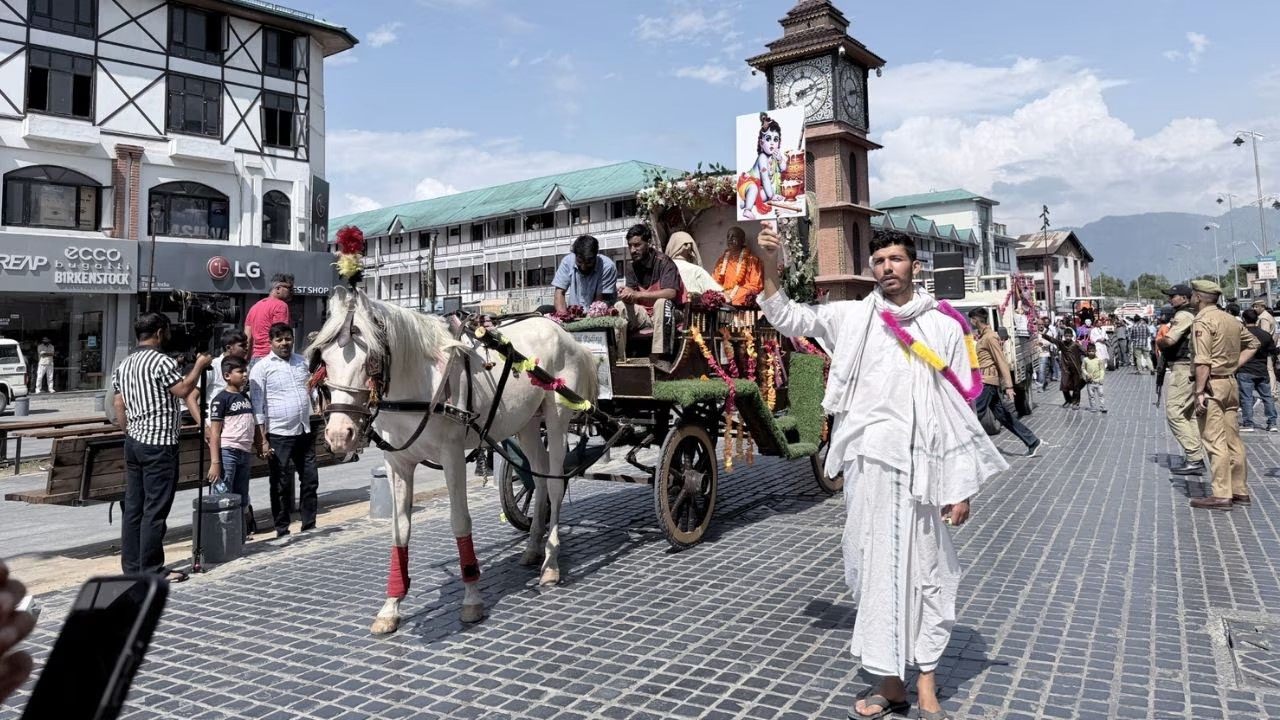
Kashmiri Pandits marked the birth of Lord Krishna — a poetic embodiment of divine love, a towering figure of India’s spiritual and cultural history, and a timeless teacher — at Srinagar’s iconic Lal Chowk this Janmashtami, in a celebration that once again underscored the Valley’s rich, diverse, and deeply rooted cultural heartbeat.
A Longstanding Tradition at Lal Chowk
The Janmashtami procession, or Shobha Yatra, has for years been a familiar sight at Lal Chowk, one of Srinagar’s most historic and symbolically significant landmarks. Organised by the Kashmiri Pandit community, the celebration typically begins at temples such as the Ganpatyar or Habba Kadal temple, with devotees carrying idols and chanting hymns in praise of Lord Krishna as they process through the city’s central streets.
This year’s celebrations saw devotees dressed in vibrant traditional attire, with children often adorned as Krishna and Radha, singing devotional songs and distributing prasad along the route. Special prayers, bhajans, and community langars were organised at temples across the city to mark the occasion, reflecting the deep religious and cultural significance the festival holds for the community.
A Celebration Rooted in Continuity, Not Novelty
While celebrations at Lal Chowk have occasionally been described in some circles as historic “firsts,” Janmashtami processions have in fact been a recurring feature of Srinagar’s cultural calendar for decades, continuing intermittently even through difficult periods in the Valley’s recent history. What each year’s celebration truly represents is not a singular breakthrough, but a continuation of a tradition that Kashmiri Pandits have worked to sustain and revive over the years, often amid significant logistical and security challenges.
This continuity itself carries significance — a reminder that the Valley’s cultural fabric has never been defined by a single community or tradition alone, but by centuries of coexistence among diverse faiths and practices.
A Reminder of the Valley’s Diversity
The celebration of Janmashtami at Lal Chowk serves as a powerful reminder that Kashmir’s cultural heartbeat has always been rich, diverse, and deeply rooted — shaped by the traditions of Kashmiri Pandits, Muslims, Sikhs, and other communities who have coexisted in the Valley for generations. Local residents from other faiths have often participated in or extended greetings during such celebrations, reflecting the enduring spirit of communal harmony that many in the Valley continue to uphold.
This diversity, spanning religious traditions, languages, and customs, remains one of Kashmir’s defining characteristics — a heritage shaped as much by its temples and shrines as by its shrines and mosques, its festivals as much as its landscapes.
Beauty Beyond Borders and Narratives
Kashmir was — and continues to be — beautiful in countless ways: in its traditions, its people, its landscapes, and its spirit. The Valley’s identity has never rested on a singular narrative, but on the layered histories and cultures that have shaped it over centuries. Any attempt to tarnish that image, for whatever reason, ultimately diminishes only those who choose to do so — never the Valley itself, whose beauty and resilience have endured through decades of change.
A Living Legacy
As Kashmiri Pandits once again gathered at Lal Chowk this Janmashtami to celebrate the birth of Lord Krishna, the occasion stood as more than a religious observance — it was a living testament to the Valley’s enduring cultural diversity and its community’s determination to preserve traditions that have long been part of its identity. In doing so, the celebration reaffirmed that Kashmir’s true spirit lies not in division, but in the coexistence and shared heritage of all who call it home.
